

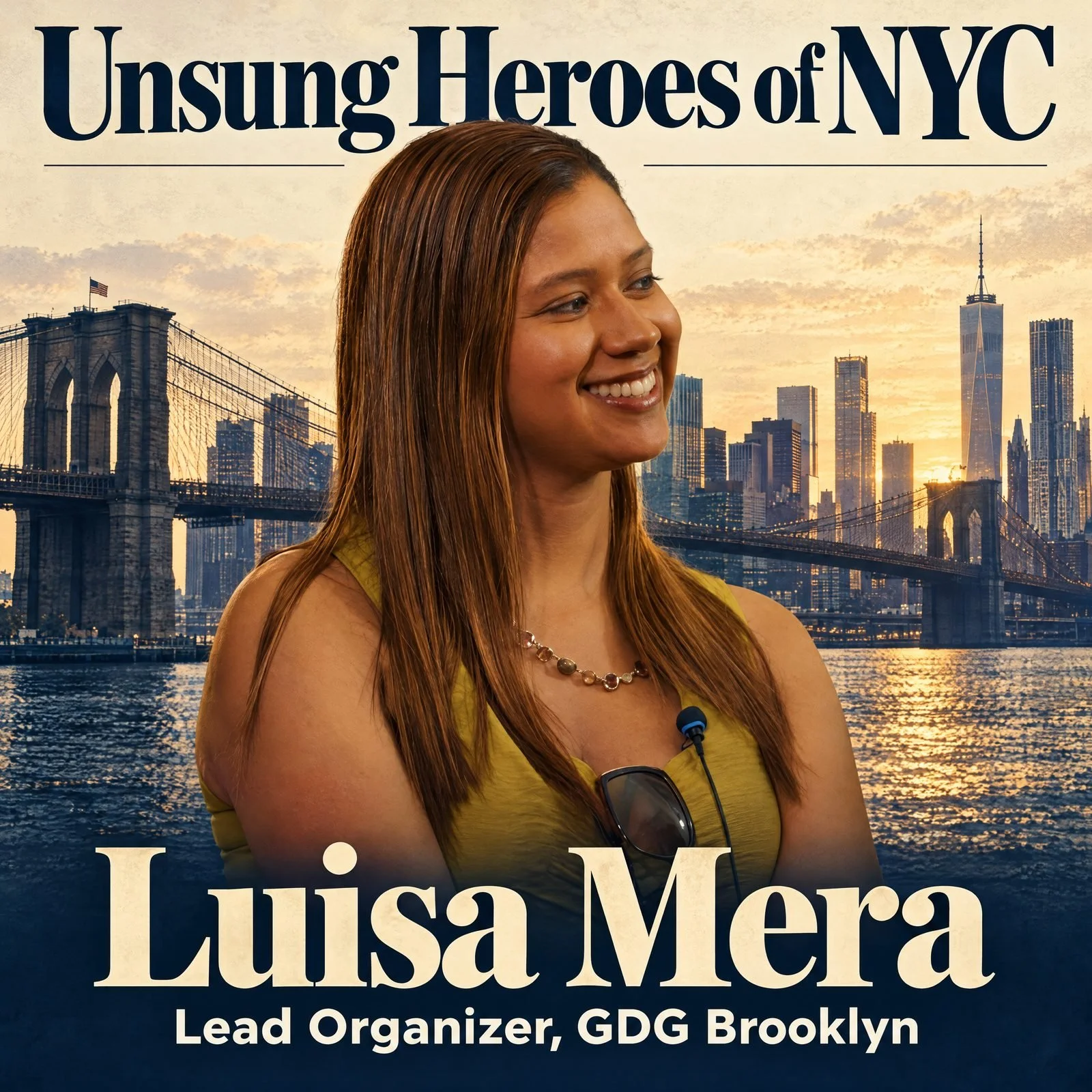
The product manager behind some of New York’s free AI workshops has an invitation for parents, shop owners and anyone who’s never written code: bring a problem you know better than an engineer does.
By Gideon Fox
Luisa Mera’s mother can have a conversation with an AI in Spanish. Gmail gives her trouble. Mera offered both facts on AI & The Law, and it’s hard to think of a better test of that familiar phrase, good with technology. Which technology? In whose language? And good at doing what?
Mera came to community work through physics. She wanted the science she cared about to be useful to the people around her: students, parents, somebody trying to run a small business. By day she works as a product manager. She explains to the business side what the engineers want to build, then goes back to the engineers with what the business actually needs. In her telling, the return trip is half the job.
As lead organizer of GDG Brooklyn, the borough’s volunteer-run Google Developer Group, Mera extends that courtesy to people who don’t usually get a say in what software does. Consider a Thursday evening workshop she helped organize with Riddhi Patel and their chapter colleagues at General Assembly on East 21st Street. The premise was that a beginner could describe an idea in plain English and spend the evening turning it into a first app. Admission was free. There would be an expert to guide the build and people to help when something broke. That last part matters if you’ve ever downloaded the software for a class and gotten stuck before the class even started.
There’s another side to the work that rarely makes it onto a conference program. Mera is also a Women Techmakers ambassador. She and Anabelle Capois Espinal invited fellow organizers to Monk McGinns on Murray Street ahead of New York’s 2025 International Women’s Day events. The people they wanted around the table were the ones looking for speakers, partners and resources for gatherings of their own. Long before a woman gets introduced onstage, someone planning the program has to know her name.
For somebody so keen on putting AI in more hands, Mera has little patience for taking its answers on faith. On AI & The Law, she reached for CliffsNotes to explain why. A study guide could get you through the homework. The trouble came when the teacher wanted you to explain the book. She expects something similar of the professionals building these tools: if a product could put someone at risk, the time to ask how is while the team is still deciding what to build.
At MetroLALSA’s Pa’Lante conference, Mera moderated a panel on data privacy, cybersecurity and the future of law. At AI Builder Day at NYU Tandon, which she helped organize, the schedule set aside hours for participants to build and show their own prototypes. By October’s Brooklyn DevFest, the stakes of doing that work well had a particularly New York illustration: a map. In an interview Attorneys with Swag recorded there, Google Earth engineer Veronica Isabel Polanco explained that her team has to consider someone who can’t see the map, both when designing a feature and when testing it. A map can look beautiful and still fail that test.
Mera’s advice for a first AI project is modest. Try building something that helps with a résumé, she suggested, or a tool for putting a recipe together. The recipe is a particularly good place to start. You know what’s in your kitchen. You know who’s coming to dinner. For once, the person who’s new to the technology is the one who gets to tell it what it needs to know.
